


ENDURANCE: Your Professional CNG Dispenser For Car Supplier
Chongqing Endurance General Equipment Co.,Ltd is a comprehensive service company integrating manufacturing, installation and maintenance services. We mainly provide customers with energy equipment cleaning service. In addition, we also offer modern industrial greenhouse design and construction, equipment manufacturing and sales, engineering installation and testing services, such as CNG and LNG whole station design and manufacturing. The company's products are safe, stable and reliable in the use of gas station projects in Uzbekistan, Kazakhstan and other cities in China, and are well received by users!
Why Choose Us?
High Quality
Quality assurance is reliable, we have a complete machine test, it will test the reliability, functions, safety of the equipment. Our products are manufactured or executed to a very high standard, using the finest materials and manufacturing processes.
Professional Team
We have an excellent team that provides technology research and development, assembly manufacturing, and after-sales service. We collaborate and communicate effectively with each other, and are dedicated to delivering high quality results. We are capable of handling complex challenges and projects that require our specialized expertise and experience.
Advanced Equipment
Our machines, tools or instruments designed with advanced technology and functionality to perform highly specific tasks with greater precision, efficiency and reliability.
Perfect Service
ENDURANCE is available and dependable to provide support and solutions to customers at all times. We try and respond to all concerns within 24 hours and our teams are always at your disposal in case of any emergencies.

After high-pressure vaporization, the water bath vaporizer, CNG Storage Cascade into the priority panel, through automatic distribution, is stored in three groups of high, medium, and low-pressure CNG cylinders. When the distributor refuels the vehicle, the system automatically controls three groups of CNG cylinders to supply gas to the distributor. The process has a high degree of automation, realizing one-click filling, reducing the start-up frequency of the high-pressure pump, and reducing the probability of failure.

A mobile CNG (Compressed Natural Gas) station is a portable system designed to compress and dispense natural gas for use as a vehicle fuel. Unlike traditional fixed CNG stations, which are permanently installed at specific locations, mobile CNG stations offer greater flexibility and can be easily moved to different sites as demand dictates.

An integrated CNG (Compressed Natural Gas) station is a comprehensive facility designed for the storage, compression, and dispensing of natural gas as a vehicle fuel. It typically includes several key components that work together seamlessly to provide a complete solution for refueling CNG-powered vehicles.

A CNG daughter station, also known as a satellite station, is a smaller-scale compressed natural gas (CNG) refueling facility that is connected to a larger, centralized main CNG station. This type of station is designed to serve as an additional point of access for refueling CNG vehicles, expanding the reach of the main station without the need for each location to have its own full-scale compression capabilities.

CNG Filling Post For Tube Trailer
A CNG filling post for a tube trailer is a specialized setup used to transfer compressed natural gas (CNG) from a tube trailer, which is a large, mobile container filled with compressed natural gas, to a CNG vehicle or another storage system.

A High Flow CNG (Compressed Natural Gas) Dispenser is an advanced refueling system designed to deliver CNG to vehicles at a faster rate than standard dispensers. It is engineered to handle the higher pressures and flow rates required by heavy-duty trucks and buses that have larger onboard CNG storage tanks and higher refueling demands.

A posterior natural gas dryer, also referred to as a coalescing filter or coalescent filter, is a device used in natural gas processing to remove water vapor and liquid droplets from the gas stream. It is typically positioned downstream of the primary desiccant dryer in a CNG (Compressed Natural Gas) plant or distribution system.

A front natural gas dryer is a component in a natural gas processing system that is responsible for removing moisture from the gas before it enters subsequent stages of drying or other treatment processes. This type of dryer is usually the first line of defense against water contamination in the natural gas stream and serves to prevent hydrate formation, which can cause equipment blockages and corrosion.

CNG Loading And Unloading Column
A CNG (Compressed Natural Gas) loading and unloading column is a piece of equipment used in the process of transferring CNG between different storage systems or transportation methods, such as from a tube trailer to a stationary storage tank or vice versa. The column acts as an intermediary station where the gas can be offloaded from one vessel and loaded into another.
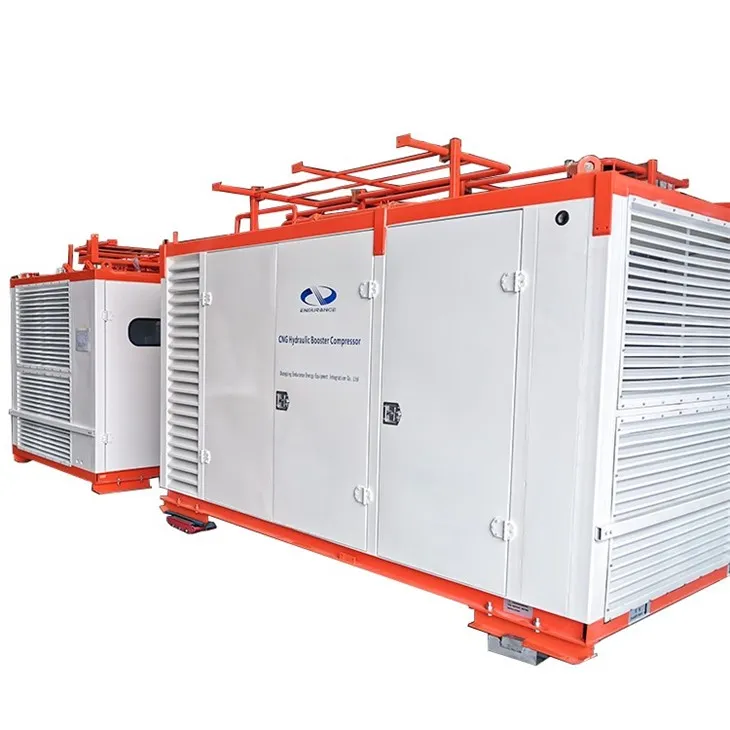
A CNG (Compressed Natural Gas) dispenser for cars is a device designed specifically for refueling passenger vehicles powered by compressed natural gas. It is similar to a conventional gasoline or diesel pump but is configured to handle CNG, which is stored at high pressures (usually 3,000 to 3,600 psi).
Features of CNG Dispenser For Car
Pressure Reduction System
Since CNG is stored at high pressures, the dispenser includes a pressure reduction system to lower the pressure to a level that's safe for the vehicle's fueling system, typically around 250 to 3,000 psi.
Flow Meter
A flow meter measures the volume of gas dispensed, which is essential for accurate billing and ensuring that the vehicle is refueled to the desired level.
Electronic Payment Interface
Modern CNG dispensers often come with an electronic payment interface that allows for secure transactions using credit cards, debit cards, or RFID technology.
LCD Display or User Interface
A display or interface provides information to the user, such as the price per unit, the total cost of the fueling, and how much gas is being added to the vehicle.
Types of CNG Dispenser For Car
Fast-Fill CNG Station
Generally, fast-fill stations are best suited for retail situations where vehicles arrive randomly and need to fill up quickly. All public CNG stations have a fast-fill option. Fast-fill stations receive fuel from a local utility line at a low pressure and then use a compressor on site to compress the gas to a high pressure. Once compressed, the CNG moves to a series of storage vessels so the fuel is available for a quick fill-up. CNG can also be delivered via dispensers alongside gasoline or other fuel dispensers.
Time-Fill
Time-fill stations are used primarily by fleets and work best for vehicles with large tanks that refuel at a central location every night. At a time-fill station, a fuel line from a utility delivers natural gas at a low pressure to a compressor on site. Unlike fast-fill stations, vehicles at time-fill stations are generally filled directly from the compressor, not from fuel stored in high pressure vessels. The size of the compressor needed depends on the number of vehicles to be fueled.
Combination-Fill
Combination-fill stations include both the fast-fill and time-fill components in one system. The vehicles connected to the time-fill posts are filled directly from the compressor, usually overnight. Vehicles at the fast-fill dispensers are filled from the storage vessels or from the compressor, depending upon need.
Dispenser Cabinet
This is the main body of the dispenser, which houses the electronic controls and meters. It is designed to protect the internal components from the environment.
Nozzle
The nozzle is the part of the dispenser that connects to the vehicle's fuel inlet. It often includes a breakaway feature to prevent damage in case the hose is pulled too hard.
Hose
The high-pressure hose carries CNG from the dispenser to the vehicle's fueling receptacle. It is designed to withstand the high pressures associated with CNG.
Pressure Regulator
This reduces the high pressure of the CNG from the storage tank to a pressure that is safe for the vehicle's fueling system.
Flow Meter
A flow meter measures the volume of gas dispensed, which is essential for accurate billing.
Electronic Payment Interface
This allows for secure transactions using credit cards, debit cards, or RFID technology.
Display Screen
Provides information to the user, such as the price per unit, the total cost of the fueling, and how much gas is being added to the vehicle.
Emergency Stop Button
This safety feature allows for immediate cessation of the fueling process in case of an emergency or malfunction.
Leak Detection Systems
Sensors are in place to detect gas leaks and trigger alarms.
Overfill Prevention Device
Stops the dispensing of gas once the tank is full or when a certain pressure threshold is reached.
Anti-Theft Features
Such as locked nozzles that require a key or a special card to operate.
Pulser or Encoder
Sends electronic signals to the dispenser's computer system, providing real-time data on the amount of fuel dispensed.
Interlock System
Ensures that the dispenser cannot operate unless all safety checks have been completed.
Hose Reel with Breakaway Coupler
The hose reel allows the hose to be easily extended and retracted, while the breakaway coupler ensures that if the hose is pulled too far or with excessive force, it will detach from the dispenser.
How to Choose CNG Dispenser For Car
Compatibility With Vehicle
Check that the dispenser's nozzle and pressure settings are compatible with your vehicle's CNG filling system. Most CNG vehicles use either a Type 1 or Type 3 cylinder, and the dispenser should be able to accommodate the corresponding connection type.
Pressure Requirements
Ensure the dispenser can handle the operating pressure of your CNG storage tank. Typically, CNG dispensers operate between 2,000 to 3,600 psi, but the exact requirement depends on your vehicle's specifications.
Flow Rate
Consider the dispenser's flow rate, which indicates how quickly it can deliver fuel. A higher flow rate can reduce refueling time, but it may also increase the load on your vehicle's fueling system.
Safety Features
Look for a dispenser with multiple safety features, such as automatic shut-off in case of overpressure, leak detection sensors, and emergency stop buttons. These features are crucial for preventing accidents during refueling.
Ease of Use
Choose a dispenser with an intuitive interface and clear instructions for ease of operation. Some models include LCD displays or touchscreens for user-friendly interactions.
Maintenance and Support
Consider the availability of maintenance services and technical support. A reputable manufacturer should offer warranties, troubleshooting guides, and access to replacement parts.
Our Factory
Our Certificate


Frequently Asked Questions
Hot Tags: cng loading and unloading column, China cng loading and unloading column manufacturers, suppliers, factory, cng filling vehicle benefit kit, CNG Gas Station, , , Associated Gas Dehydrocarbonization Unit


